Are These Judgments
Literal or Symbolic
Did you notice that
each trumpet judgment produces a literal
result? For example, in verse 7,
fire comes down from the sky and burns
up a third of the trees and
vegetation. In verse 9, a third of
the ships sink after a
great mountain impacts the sea. In
verse 11, people die from
drinking poisoned water after a
blazing star impacts Earth. These
events are consistent with the laws
of physics, so it is possible the
first four trumpets are literal
descriptions of literal events. In
other words, what else would fire,
trees, and vegetation symbolize in
the first trumpet if not fire, trees
and vegetation? What else sinks real
ships and causes real people
to die if not two great asteroid
impacts? For that matter, what do the
sea creatures and people drinking
poisonous water represent in verse 11
if not real sea creatures and real
people? What else could the sun,
moon, and stars represent in verse 12
if not the sun, moon, and stars that
are normally visible?
When it comes to
interpreting apocalyptic prophecy,
many pastors and scholars do not
understand the necessity of using
valid rules of interpretation. When
valid rules are not used, one cannot
study the Revelation and arrive at
its intended meaning. This
oversight has led many scholars to
assert that the seven trumpets are
symbolic because they believe
“the whole book of Revelation is
a book of symbolism.” If we
evaluate the core of this argument,
it is just another way of saying,
“No one really knows what
Revelation means.” For
hundreds of years this tactic has
enabled so-called experts to spin
fancy interpretations that have
little or nothing to do with the
intended meaning.
If the book of
Revelation forever remains a book of
symbolism, we face two insurmountable
problems. First, what kind of
language would God have to use if He
wanted mankind to regard the fire,
trees and vegetation in the first
trumpet as literal fire, trees, and
vegetation? What words would God have
to use if He wanted us to understand
that during the third trumpet
desperate people will drink poisoned
water out of rivers and springs and
die? If God wants the world to know
that the first four trumpets are
literal events, what would He have to
say? We know that the four phenomena
(peals of thunder, rumblings,
lightening, and the earthquake) that
precede the fiery hail of the first
trumpet are literal, and we can see
that the first four trumpets are
consistent with the laws of physics,
so treating the first four trumpets
as symbols is not a valid argument.
If the first four
trumpets are in fact symbolic
descriptions of things other than
what they say, where are these
symbols defined? When a prophetic
element is deemed symbolic, human
beings are not free to interpret
symbols according to their
imagination. There must be relevant
Bible texts to define the symbol;
otherwise, the Bible cannot speak for
itself. According to Rule Three,
every time God creates a symbol in
apocalyptic prophecy, God Himself
defines that symbol. This
simple process enables the Bible to
speak for itself, that is, without an
interpreter (pastor or scholar).
Consider two examples.
A great prostitute is introduced in
Revelation 17:1 and she is defined a
few verses later (verse 18) as
“the great city” that will
rule over the kings of Earth. The
seven stars in Revelation 1:16 are
defined a few verses later (verse 20)
as “the seven angels of the
seven churches.” These two
examples show how relevant texts
interpret symbols. When we follow
valid rules of interpretation, we are
not at liberty to go rummaging
through the Bible to find a
disconnected verse that we can apply
to something that we want to call a
symbol. When God wants something
understood as a symbol, He always
defines the symbol by declaring the
meaning of the symbol in a relevant
text. Rule Three of
apocalyptic prophecy says,
“Apocalyptic language can be
literal, symbolic, or analogous. To
reach the intended meaning of an
apocalyptic prophecy, the student
must consider (a) the context, (b)
the use of parallel language in the
Bible, and (c) relevant texts that
define the symbol if an element is
thought to be symbolic.” If we
follow this simple rule (along with
the other three), we will avoid
reaching conclusions that have
nothing to do with the intended
meaning.
Calling the first four
judgments “symbolic” is
unwarranted. God has described the
seven trumpets with language that
makes perfect sense once you
understand the full cup principle,
God’s use of vocabulary, and the
end of corporate mercy. Everyone on
Earth will see and experience the
first four trumpets when they fall.
They will be very literal and very
harmful.
Jesus Spares
Two-Thirds
Did you notice the
repetitive use of thirds in the first
four trumpets? The Bible says a third
of the trees were burned up, a third
of the ships sank, and a third of the
day was without light. “One
third” is mentioned twelve times
in the seven trumpets! This repletion
is deliberate and important because
Jesus assures us a dozen times in the
seven trumpets that He is a generous
King. To understand the ancient
practice of sparing one-third and
destroying two-thirds, we have to
examine some passages from the Old
Testament.
During Old Testament
times, if a conquering king felt that
grace was merited or that grace was
politically expedient, he would spare
one-third of his enemies after
defeating them. Notice this text: “David
also defeated the Moabites. He made
them lie down on the ground and
measured off with a length of cord.
Every two lengths of them were put to
death, and the third length was
allowed to live. So the Moabites
became subject to David and brought
tribute [paid their taxes].”
(2 Samuel 8:2, insertion mine)
King David was as
generous as he was wise. He spared
one-third of the Moabites for two redemptive
reasons. First, he felt
the surviving Moabites might have a
change of mind and gladly pay their
tribute [taxes] if he spared their
lives. (Isn’t it amazing what
people can do when motivated by
gratitude?) Second, David did not
want to destroy his tax base.
David knew that in
years to come, the Moabites would
recover from this war and repopulate.
Their future taxes would mean
additional income for Israel’s
treasury! So, David spared “a
third” of the Moabites. Now that
you understand why ancient kings
sometimes spared one-third of their
enemies, notice that Jesus followed
this principle when He destroyed
Jerusalem during the days of
Nebuchadnezzar:
“Therefore
as surely as I live, declares the
Sovereign Lord, because you have
defiled my sanctuary with your vile
images and detestable practices, I
myself will withdraw my favor; I will
not look on you with pity or spare
you. A third of
your people will die of the plague or
perish by famine inside you: a third
will fall by the sword outside your
walls; and a third
I will scatter to the winds and
pursue with drawn sword.” (Ezekiel
5:11,12, italics mine)
This last text is
another confirmation of the ancient
custom of sparing one-third and
destroying two-thirds:
“’In the
whole land,’ declares the Lord,
‘two-thirds will be struck down
and perish; yet one-third will be
left in it.’”
(Zechariah 13:8)
Now that we have
surveyed the ancient custom of
sparing one-third and destroying
two-thirds, the process of destroying
one-third in Revelation should make
sense. This repetitive language tells
us the seven trumpets are redemptive
in nature. The seven trumpets will be
mixed with mercy (remember, atonement
blood was mixed with the fire that
was cast down upon Earth). Instead of
destroying two-thirds of everything,
the Lord restrains Himself by only
destroying one-third. In other words,
Jesus is “double generous!”
Of course, very few people will think
that Jesus is double generous when He
destroys one-third of everything on
Earth, but man’s ignorance has
no bearing on God’s actions. Man
learns from God, not the other way
around. If Jesus destroyed two-thirds
of everything during the seven
trumpets, His wrath would be
justified in the eyes of watching
angels because corporally speaking,
Earth today is very similar to Earth
in Noah’s day – beyond
corporate redemption.
Sixty Days?
Earlier, I indicated
that the first four trumpets
judgments will produce death and
destruction on a biblical scale that
exceeds human calculation. These four
judgments will ruin Earth to the
extent that recovery will be
impossible. I also indicated that the
first four trumpets will occur during
a period of about sixty days. Even
though the Bible does not explicitly
declare the timing of the first four
trumpets, there is come indication
they will happen in a rapid-fire
sequence after the censer is cast
down. Please consider the following:
The Bible predicts
that mankind will quickly respond to
the first four trumpets by setting up
a crisis government called
“Babylon.” Of course,
world leaders will not call their new
creation “Babylon.” The
Bible calls this coming government
“Babylon” because its
behavior will parallel the ancient
kingdom of Babylon, both in
arrogance and ignorance. The
Bible also indicates Babylon will
persecute God’s saints for
forty-two months. (Revelation 13:5)
Because the Great Tribulation will
last approximately forty-five months
(1,335 days, Daniel 12:11,12),
Babylon has to form within ninety
days after the Great Tribulation
begins in order to persecute the
saints for forty-two months
(forty-five months minus forty-two
months leaves ninety days). Since
Babylon has to begin persecuting the
saints within ninety days after the
censer is cast down, this suggests
that the first four trumpets will
come in a rapid–fire sequence.
Here is why:
1. A
rapid-fire sequence of judgments on
notably wicked places will silence
the argument that these horrific
events were random acts of nature. If
the first four trumpets were months
apart, these judgments could be
interpreted, as random acts of nature
and the argument favoring a random
string of “natural
disasters” would be difficult to
silence. Moreover, if the first four
trumpets were months apart, nothing
else could move diverse religions and
nations to unite and form Babylon so
that the persecution of God’s
people all over the world can begin
within ninety days.
2. If the
first four trumpets were months
apart, it would be impossible to get
people to thoughtfully consider the
gospel presented by the 144,000. (The
144,000 will begin their work on the
day the censer is cast down.) Until
religious paradigms are shattered and
a theological vacuum is created,
people will not listen to a gospel
that is contrary to their current
beliefs. If the first four trumpets
do fall within a short period on
notably wicked places, this would
force reasoning people to admit that
(a) God is on the warpath against
wickedness, and (b) something must be
done quickly to appease God or He May
destroy everyone.
3. If the
first four trumpets occurred in a
rapid-fire sequence, the resulting
shock and awe would totally overwhelm
the whole world. Panic and trembling
would be so great that a war
involving nuclear exchanges would
end. Panic and fear of “The
Living God” would bring world
leaders (religious and political)
into a humble union. United by terror
and motivated by fear, they would
move quickly to appease God. Man’s
fear of more wrath explains the
sudden formation of Babylon. Everyone
on Earth will conclude that God is
angry. Of course, extreme
circumstances require desperate
solutions, and the Bible predicts
that man’s solution to appeasing
God’s wrath will be extreme
(otherwise unthinkable).
Even these factors are
combined and mathematically aligned;
it is reasonable to conclude that the
first four trumpets will occur within
ninety days. Furthermore, it seems
likely that Babylon’s
persecution could begin as early as
the sixty-four day of the Great
Tribulation. (This calculation will
be explained later.) Evidently,
Babylon forms during the darkness of
the fourth trumpet, and
Babylon’s leaders will humbly,
logically, and out of necessity, move
quickly to do everything possible to
appease God by reversing man’s
degeneracy. However, in their efforts
to do good, the leaders of Babylon
will end up doing evil- persecuting
God’s saints for forty-two
months.
Even though we have
not discussed and aligned all of the
time periods mentioned in the book of
Revelation, I hope you will consider
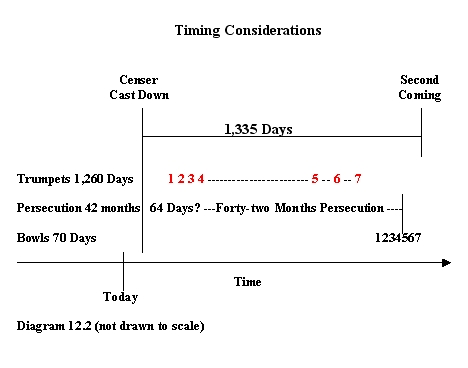
the data presented in Diagram 12.2.
As this commentary progresses through
the book of Revelation, it should
become increasingly clear that God
has left little wiggle room for
moving things around in the book of
Revelation once all the prophecies
are put on the table. For now, this
simple chart should give a basic
understanding of where this
commentary is headed.