Work with Me!
I call God’s
objectives for the seventy weeks
“Plan B.” Israel was in
captivity because it had ruined
“Plan A.” If the new Israel
cooperated with God, He would bring
an end to sin and establish His
kingdom on Earth at the end of the
seventy weeks. If Israel failed to
cooperate, God promised to destroy
Jerusalem and displace Israel with a
“new” Israel, starting over
again. One might call the next plan,
“Plan C.” Remember
Gabriel’s words: “Seventy
weeks are determined upon thy people
and upon thy holy city, to finish the
transgression, and to make an end of
sins, and to make reconciliation for
iniquity, and to bring in everlasting
righteousness, and to seal up the
vision and prophecy, and to anoint
the most Holy.” (Daniel
9:24, KJV) The objectives presented
in this verse are very similar to the
objectives God gave Israel
(“Plan A”) before entering
the Promised Land, but the essential
difference is timing. In Daniel 9:24,
God declared that He was ready to
bring in everlasting righteousness within
490 years of a particular decree!
Talk about excitement! Of course,
God’s objectives could only be
met if Israel allowed the Holy Spirit
to have dominion in the hearts of the
majority of its citizens. God said,
“Work with me and see what I
will do through you!” If
Israel had cooperated with Him, God
would have accomplished four amazing
things:
- The nation of
Israel and the city of
Jerusalem would have risen
from its ashes and flourished
above all nations as an
example of God’s
redemption. (God gave
numerous prophecies about
Israel’s restoration and
prominent role to
Daniel’s contemporary,
Ezekiel. If Israel had
cooperated with God, the
prophecies of Ezekiel would
have been fulfilled. This
is a key point that will be
discussed further at the end
of this segment, because this
point is connected to the
2,300-days prophecy.) Israel’s
redemption and release from
captivity were to be a
pattern of salvation, giving
hope to all nations of the
world that God would redeem
everyone and free them from
the captivity of sin and
rebellion if they loved Him.
The exciting news that God
gave to Daniel was that all
this could occur within
seventy weeks of years. Think
of it! God had allotted the
remaining time for sin and
rebellion on Earth to be a
mere 490 years, but only if
Israel cooperated! It is such
a tragedy to discover that
each generation in Israel
cared less and less about
this amazing opportunity as
the 490 years rolled by.
- God promised
to send His Sacrifice, the
Lamb of God, and offer Him up
for sin within 490 years. The
Savior of the world would
appear, and He would die in
the middle year of the
seventieth week. Afterwards,
Jesus would usher in
everlasting righteousness,
but only if Israel
cooperated.
- If Israel
cooperated with God, they
would have had the privilege
of anointing “The Most
Holy.” The term,
“anointing the most
holy,” is a Hebraic
concept that refers to
anointing the most holy
officer in Israel, the high
priest. (Exodus 29:21;
Leviticus 4:3; Leviticus
8:30) Even though
Israel had long anticipated
the birth of Messiah (the
word Messiah means the
Anointed One), God told
Israel they would have the
privilege of anointing the
Messiah! Tragically, He came
unto His own and His own did
not receive Him. (John 1:11)
Therefore, the Holy Spirit
anointed Jesus at His
baptism. (Mark 1:10; Luke
4:18)
- The fourth
objective was an amazing
promise. If Israel
cooperated, God promised to
seal up this vision and all
other prophecies in the book
of Daniel, because these
prophecies would not come to
pass. In other words, if the
new Israel cooperated with
God so that “Plan
B” could be fulfilled,
the course of human history
would unfold a promised under
the original plan. This is a
very important point to
understand. Once implemented,
Daniel’s prophecies
became unconditional. This
means they are not subject to
man’s cooperation to be
fulfilled. The Rock in Daniel
2 will hit the ten kings and
destroy them. The little horn
power of Daniel 7 would
appear and persecute the
saints. The goat would
overrun the ram in Daniel 8,
etc. The point is that if
the new Israel cooperated
with God, He would seal up
these visions and prophecies
given to Daniel, and their
contents would never be known
or implemented. Notice what
God is doing. God spoke to
Ezekiel at the same time He
spoke to Daniel, and God
promised a grand and glorious
future for Israel if
they would cooperate with
Him. The prophecies of
Ezekiel were conditional.
Israel would be marvelously
blessed if they chose to
cooperate with God. However,
if Israel did not cooperate,
then Daniel’s vision and
prophecies would be
fulfilled. You must see the
larger picture of what God is
doing to appreciate the
contrasting massages that God
sent to Daniel and Ezekiel.
Always Starting Over
These four objectives
have profound significance, because
they show God’s intentions if
Israel would cooperate with Him.
The prophecies of Jeremiah, Isaiah,
and other prophets pointed to a grand
fulfillment of “Plan A.”
Unfortunately, Israel did not
cooperate. Therefore, God destroyed
His temple, people and city. After
seventy years in Babylon, God offered
a new Israel “Plan B,”
promising to fulfill it within 490
years! It is hard to believe, but the
new Israel failed, too. They rejected
God and they rejected God’s Son.
(Luke 20: 9-19; John 1; Romans 9-11)
Therefore, God destroyed His temple,
people and city a final time in A.D.
70. (There is another seventy –
A.D. 70!) Mercifully, God started
again with plan “Plan C.”
Under this plan, God redefined
Israel. Israel includes anyone who
will believe in His Son, Jesus
Christ. (Ephesians 2, Galatians 3)
Under “Plan C,” there is a
new covenant that is even better than
the former covenant.
If I were to identify
the primary reason for so much
prophetic confusion among Christians
today, it would have to be this:
Scholars are still trying to figure
out ways for God to fulfill the many
Old Testament prophecies that belong
to “Plan A” and “Plan
B.” However, these scholars are
wasting their efforts because God has
implemented “Plan
C.” Instead of looking forward
to a rebuilt temple in old Jerusalem,
we should be looking forward to a
rebuilt Jerusalem that comes from God
out of Heaven. The exciting news is
that there will be no temple in the
New Jerusalem because the Father and
the Lamb will be among their people.
(Revelation 21:2,22) Think about
this: If Israel had cooperated with
God during the 490 years, there would
have been no need for a Second
Coming. Nowhere in the Old Testament,
other than the book of Daniel, is
there a mention of a Second Coming.
Instead, God would have established
His kingdom on Earth at the end of
the 490 years! Sin would have ended
and everlasting righteousness would
have begun.
Back to Gabriel’s
Statements, Numbers 2 and 3
“Know and
understand this: From the issuing of
the decree to restore and rebuild
Jerusalem until the Anointed One, the
ruler, comes, there will be seven
‘sevens,’ and sixty-two
‘sevens.’ It will be
rebuilt with streets and a trench,
but in times of trouble.” (Daniel
9:25)
Four decrees were
issued for the restoration of
Jerusalem. Cyrus gave the first
decree in the Friday year of 536 B.C.
(Ezra 1) Darius gave the second
decree in the Monday year of 519 B.C.
(Ezra 6) Artexerxes gave the third
and fourth decrees in the Sunday year
of 457 and the Sabbath year of 444
B.C. (Ezra 7 and Nehemiah 2,
respectively) Remember that God used
the word ‘weeks” instead of
years to indicate the synchrony for
this all important decree with His
weekly cycle of years established at
the Exodus. In verse 25, Gabriel adds
another specification that identifies
which of the four decrees God will
use to count off the seventy weeks: “From
the issuing of the decree to restore
and rebuild Jerusalem until the
Anointed One, the ruler, comes, there
will be seven ‘weeks’ and
sixty-two
‘weeks….’”
With these words, Gabriel points to
the public ministry of Messiah.
Gabriel used seven weeks and
sixty-two weeks to highlight the
all-important synchrony of a decree
that would occur in a Sunday year and
at the beginning of a Jubilee
cycle of seven weeks. (See Chart 6.5)
By separating the 69 weeks into
smaller pieces – the first of
which was a Jubilee cycle, God was
doing everything He could to help
Israel identify the right decree.
Notice how this works: In verse 24,
God points to a decree that occurs on
a Sunday year by using the words
“seventy weeks.” (Weeks
always begin with a Sunday year.) In
verse 25, God indicates the decree
will occur at the beginning of
“seven weeks” or 49 years.
A seven-week cycle is a Jubilee cycle
of forty-nine years and it always
begins with Sunday year. Only one of
the four decrees meets this
specification. The decree in 457 B.C.
occurred in a Sunday year, which also
happens to start a new cycle of seven
weeks (Jubilee cycle). Incidentally,
if 457 B.C. is a Jubilee year, so is
702 B.C., the only Jubilee year
mentioned in the Bible. (Isaiah
37:30) God uses language so plain
that wise men from Ur figured it out!
However, the religious leaders in
Jerusalem never did figure it out.
Religion can be so blinding.
Great Clocks from
God discusses the year of the
Exodus (1437 B.C.) and many other
issues that accompany this topic.
Please go to the reading room and
click on to Great Clocks from God.
For this study, just consider the
possibility that 457 B.C. is a Sunday
year and 457 B.C. is the first year
of a Jubilee cycle. From the Bible we
learn that on or about the very first
day of the first month of the year of
Jubilee (Nissan 1), King Artaxerxes
issued a decree providing for the
refurbishing of Jerusalem and its
temple. (Ezra 7) We also know
that Ezra left Babylon with the
decree in his hand on Nissan 12, the
twelfth day of the first month! (Ezra
8:31)
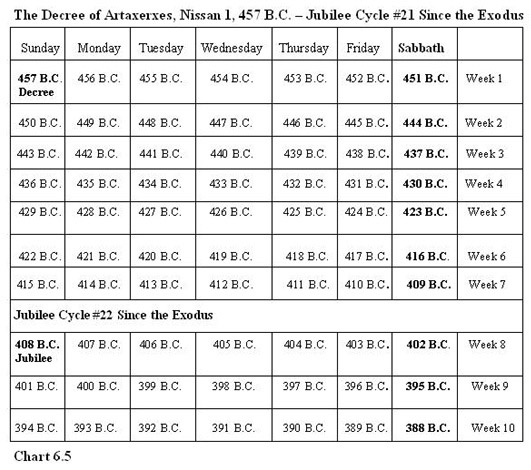
Look at Chart 6.5 and
count off the “seven weeks”
which Gabriel mentioned (457 –
409 B.C.). Notice that the first week
of the “sixty-two weeks”
Gabriel mentioned began with 408
B.C., and if this chart extended long
enough, the 69th week
would end with the Sabbath year of
A.D. 26. Notice that 457 B.C. is both
a Sunday year and a Year of Jubilee.
(Remember, the Year of Jubilee is the
fiftieth year of the old Jubilee
cycle, and it is also the first year
of the new Jubilee cycle.) None of
the other decrees to restore and
rebuild Jerusalem can satisfy the
synchrony that God indicates in
Daniel 9. Therefore, none of the
other decrees can meet the
“seven weeks and sixty-two
weeks” requirements that Gabriel
specified. If this information does
not convince the reader, history
proves these three decrees cannot
meet the Daniel 9 specifications
either. Here’s how:
If 457 B.C. is the
correct decree and it marks the
beginning of the seventy weeks, then
we should expect the appearing of
Messiah “seven and sixty-to
weeks later” (69 x 7 = 483
years), in the Sunday year of A.D.
27. History precisely confirms this
to be the case! Jesus waited until
His thirtieth birthday, which
occurred in the Fall of A.D. 27., to
begin His ministry. Notice how Luke
documents the year of Jesus baptism: “In
the fifteenth year of the reign of
Tiberius Caesar – when Pontius
Pilate was governor of Judea, Herod
tetrarch of Galilee, his brother
Philip tetrarch of Iturea and
Traconitis, and Lysanias tetrarch of
Abilene…. The people were
waiting expectantly and were all
wondering in their hearts if John
might possibly be the Christ.” (Luke
3:1,15) Have you wondered why people
thought John the Baptist might be the
Christ? I believe people were
expecting Christ because they knew
that 483 years had lapsed since the
decree of Artaxerxes. The year had
come for the messiah to appear and
John the Baptist; a forerunner of
Messiah was attracting a lot of
attention because the power of the
Holy Spirit rested upon him. (Luke
1:17) Within this context Luke wrote,
“When all the people were
being baptized, Jesus was baptized
too. And as he was praying, heaven
was opened and the Holy Spirit
descended on him in bodily form like
a dove. And a voice came from heaven:
‘You are my Son, whom I love;
with you I am well pleased.’ Now
Jesus himself was about thirty years
old when he began his
ministry….” (Luke
3:21-23)
Tiberius and A.D. 27
Some scholars claim
that the fifteenth year of Tiberius
cannot be A.D. 27., but it was the
fifteenth year of the Jews! The
Romans did not date Caesar’s
rule with regnal years. Rather, the
official count of years in roman
service was determined by the years
Tiberius held tribunician power.
Therefore, A.D. 14 would have been
the 33rd or 34th year of
Tiberius’ tribunician power
(Tiberius was granted power as a
member of the tribune in 6 B.C.) I
raise this point because Luke dates
the fifteenth year of Tiberius
according to Jewish tradition, not
Roman tradition. The fifteenth year
of Tiberius, according to Jewish
tradition, began in the fall of A.D.
27. Here’s how:
History says that on
August 19, A.D. 14, Augustus died.
Tiberius maneuvered the Senate for a
few weeks and did not allow it to
name him emperor for almost a month.
On September 17, A.D. 27, Tiberius
became the emperor of Rome at age 56.
Because this is what history says, we
find that Luke follows the Jewish
tradition of inclusive dating. This
means Luke counted the ascension year
of Tiberius as “year 1,”
even though the ascension year was
just a few days in length before a
new civil year began on Tishri 1.
Josephus also followed this practice
when he dated the reigns of the
Herods. (Antiquities xv. 5.2; xvii.
8.1) The Mishnah further confirms
this method of Jewish regnal
reckoning. (Mishnah Rosh Hashanah
1.1)
During the time of
Christ, the Jews observed a
fall-to-fall civil calendar. The
first month of this calendar was the
seventh month of religious year. It
was called Tishri. Therefore,
Tiberius ascended to the throne on
September 17, A.D. 14, during a
Jewish civil year that ended about
two months later (November 11, A.D.
14.) Therefore, Luke counted
inclusively, ascended to the throne
that year. Therefore, the Jews
regarded the following civil year
Tishri-to-Tishri 1 (November 12, A.D.
14 to October 31, A.D. 15), as the
second year of Tiberius’ reign.
(See Chart 6.6.)
Luke’s Account:
The Reign of Tiberius Caesar
Year 1 =
A.D. 14/14 (September 17 –
November 11)
Year 2 =
A.D. 14/15 (Tishri 1 to Tishri 1)
Year 3 =
A.D. 15/16 (Tishri 1 to Tishri 1)
Year 4 =
A.D. 16/17 Etc.
Year 5 =
A.D. 17/18
Year 6 =
A.D. 18/19
Year 7 =
A.D. 19/20
Year 8 =
A.D. 20/21
Year 9 =
A.D. 21/22
Year 10 = A.D. 22/23
Year 11 = A.D. 23/24
Year 12 = A.D. 24/25
Year 13 = A.D. 25/26
Year 14 = A.D. 26/27
Year 15 = A.D. 27/28
Chart 6.6
Chart 6.6 shows Tishri
1 to Tishri 1 (October 19, A.D. 27
through November 6, A.D. 28) as the
15th year of Tiberius.
According to Roman dating, Jewish
reckoning and Luke’s report,
Jesus was baptized in the fall of
A.D. 27, sometime after Tishri 1.
(The length of Christ’s public
ministry on Earth was almost 32
months.) Just as Gabriel predicted,
Jesus arrived at the banks of the
Jordan River where John baptized Him.
Jesus began His public ministry in
the Sunday year of A.D. 27, which is
the first year of the seventieth
week! This is not the end of the
story. To additional facts from
history, confirm this synchrony of
the Jubilee Calendar. In short,
God’s timing is astonishing.
The Wise Men
The story of
Jesus’ birth includes a
surprising visit by the Magi from the
East. Many people do not realize the
Magi were careful students of
prophecy. Scholars believe they were
clergymen from Ur, in the province of
Babylon. Evidently, they had
discovered and deeply studied
Daniel’s writings, as well as
other books of the Old Testament. The
Magi understood that priests and
kings in Israel were typically thirty
years of age when thy ascended to
authority. (Numbers 4; Genesis 41:46;
1 Samuel 13:1; 2 Samuel 5:4; 1
Chronicles 23:3) Using this
information, they determined when the
sixty-nine weeks would end. Then,
they subtracted thirty years from the
calculation to determine the year of
Messiah’s birth. When they saw
the star appear in the heavens, they
knew it was a sign from God.
Think about it. Their
round-trip journey to see baby Jesus
required them to travel more than a
thousand miles over a period of a
year. The intensity of their desire
to see the Messiah was obvious. Their
lavish gifts for baby Jesus reveals a
love for God that few Jews could
understand. (The gifts from the Magi
financially sustained Mary, Joseph,
and Jesus during their exile in Egypt
when they escaped Herod’s decree
to kill all baby boys less than two
years of age.) Wise men do not go to
these extremes on a whim. Like Simeon
and Anna (the elderly prophets of
Israel who longed to see Messiah
before they died), the wise men
longed to see the Savior of the world
with their own eyes. Their visit was
a powerful affirmation that the
decree of Artaxerxes in 457 B.C. is
the correct decree for starting the
483-year countdown. Consider their
question to King Herod: “Where
is the one who had been born king of
the Jews? We saw his star in the east
and have come to worship him.”
(Matthew 2:2) They were not
questioning whether the king of
the Jews had been born. Perhaps
they did not have access to
Micah’s writings. If they did,
they could have gone directly to
Bethlehem. (Micah 5:2) Their presence
in Jerusalem at just the right time
suggests they understood Daniel 9,
since no other prophecy in the Bible
pinpoints the time of Messiah’s
birth.
How could mere
“Gentiles” from a distant
land be better informed on the timing
of Messiah’s appearing then
Jewish Scholars? How did the
Samaritan woman at the well know
Messiah’s coming was near. She
anticipated the appearing of the
messiah because she said: “…
I know that Messiah (called Christ)
is coming … when he comes, he
will explain everything to us.” (John
4:25) The answer is simple. Centuries
earlier, the Lord had said, “You
will seek me and find me when you
seek me with all your heart.” (Jeremiah
29:13) Unfortunately, Jewish scholars
were not looking for Jesus. They were
caught up in their tiny world of
pseudo-scholarship. They had
nit-picked the Word of God into so
many senseless pieces; they could no
longer see the big picture. Even
though the religious leaders
discussed and debated the prophecies
of Daniel between themselves, they
could not understand Gabriel’s
words. Ironically, the same situation
appears to be true today. Scholars
still twist and distort
Gabriel’s words. Sadly, they
have led millions of people to
anticipate a non-existent
pre-tribulation rapture by tampering
with the seventy weeks.
Jesus Died in the
Middle of the Seventieth Week!
God’s timing is
incredibly perfect. Let us review the
facts. First, 457 B.C. aligns with
the weekly cycle of years that began
operating at the Exodus in 1437 B.C.
Second, 457 B.C. aligns with the
forty-nine year Jubilee cycles that
began operating at the Exodus. Third,
Messiah appeared sixty-nine weeks
after 457 B.C., in A.D. 27, to be
baptized by John the Baptist. Fourth,
457 B.C. was affirmed by the wise men
shortly after Jesus was born. The
fifth and best proof that 457 B.C.
decree is the one indicated in Daniel
9, is the timing of Jesus’
death. Basically, Jesus began His
ministry on time and He died on time.
The death of Jesus not only confirms
the synchrony of the Jubilee
Calendar, it also confirms the decree
of Artaxerses in 457 B.C. to be the
right decree. Paul was aware of this
phenomenon: “But when the
time had fully come, God sent his
Son, born of a woman, born under the
law… You see, at just
the right time, when we
were still powerless, Christ died for
the ungodly.” (Galatians
4:4; Romans 5:6, italics mine)
Gabriel’s
Statement Number 3
Gabriel said, ‘After
the sixty-two ‘sevens,’ the
Anointed One will be cut off and will
have nothing …. He will confirm
a covenant with many for one
‘seven.’ In the middle of
the [last] ‘seven’
he will put an end to sacrifice and
offering.” (Daniel 9: 26,27,
insertion mine) Look ahead to Chart
6.7. Notice how A.D. 30 is located in
the middle of the seventieth
week of years. Of course, Christians
have no question that Jesus confirmed
the covenant that God gave to
Adam and Eve, as well as Abraham and
his descendants. There should be no
doubt in any mind that he put an end
to animal sacrifices and ceremonial
offerings when He died on the cross.
(Colossians 2) Yet, very few
Christians realize that Daniel
predicted Jesus’ death and Jesus
fulfilled Daniel’s prophecy when
he died in the middle of the
seventieth week!
page l 1 l 2 l 3 l 4 l 5 l 6 l 7 l 8 l 9 l



