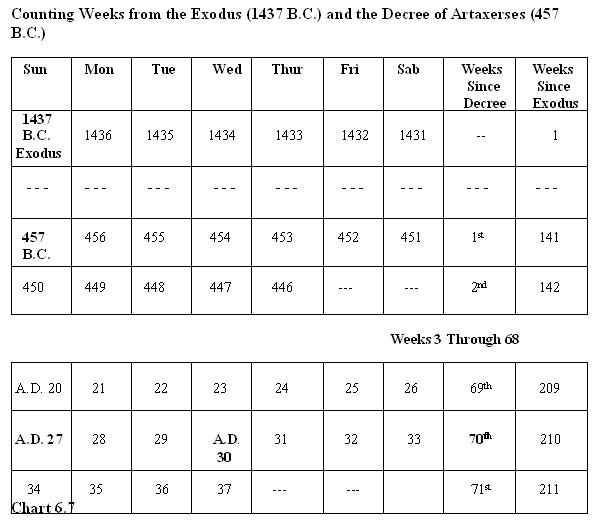
Look again at Chart
6.7. Counting from the decree of
Artazerxes, notice that A.D. 30 is in
the middle of the seventieth week.
Notice that A.D. 30 occurs in the
middle of the 210th week
counting from the Exodus in 1437 B.C.
Notice that the seventy weeks of
Daniel 9 began at the beginning of
the 141st week (or 987
years) since the Exodus, and also
notice that the seventieth week
terminates 210 weeks of years, which
is exactly thirty Jubilee cycles
since the Exodus.
Proving A.D. 30 is the
year of Christ’s Death
Daniel 9:27 says, “…
In the middle of the
‘seven’ [or week] he
will put an end to sacrifice and
offering.” Gabriel said that
Jesus would die in the middle of the
seventieth week. (See Chart 6.7)
Since we know that Jesus died at the
time of the Passover (John 12), and
since there is widely accepted
astronomical data for A.D. 30 that is
accurate to within two hours, there
is sufficient evidence to prove
beyond reasonable debate that Jesus
was crucified on Friday, April 7,
A.D. 30. (There is another signature
seven in April 7!) If we follow Bible
history and the synchrony of
God’s Great Clocks to resolve
the question of the time of His
death, all of the data presented in
the Gospels concerning Christ’s
passion week harmoniously fits
together. In fact, A.D. 30 exclusively
satisfies the synchrony required
by all seven clocks that the Creator
devised! A.D. 30 is the only
year during which all of the events
described in Scripture could have
occurred.
How Israel Measured
Time
The Jews measured time
inclusively. Any part of a year month
or day counted as a whole unit.
Remember how Tiberius came to power
about two months before Tishri 1 (the
beginning of a Jewish civil year),
but Luke counted those two months as
a whole year. (Luke 3:1)
Similarly, if someone came to your
home on Tuesday and left on
Wednesday, the ancients would measure
the time your guest visited in your
home to be two days and two nights
–Tuesday and Wednesday –
even though the actual time was less
than twenty-four hours. Because a day
consists of a dark portion and a
light portion, any part of two days
was called “two days and two
nights” This inclusive method
for measuring time explains how Jesus
could be dead for three days and
three nights (Matthew 12:40), even
though the Bible says the Father
resurrected Jesus on – not after
– the third day (Acts 10:40),
which was Sunday, the first day of
the week. (John 20:1-5) Using
inclusive reckoning, Jesus was in the
tomb for three days and three nights:
Friday, Sabbath and Sunday. However,
He was slain on Friday afternoon,
rested in the tomb on Sabbath and
resurrected on Sunday. The number of
hours that Jesus was dead was less
than forty hours (two hours on Friday
afternoon, twenty-four hours on
Sabbath and ten to twelve hours on
Sunday). The timing of this matter
can be demonstrated beyond the point
of reasonable controversy!
One more point about
inclusive measurement of time.
Eighteen prophetic time periods are
in Daniel and Revelation’s
seventeen prophecies, and from
God’s perspective, all of them
use inclusive reckoning. The
decree of Artaxerxes in 457 B.C.
occurs during the first year of the
seventy weeks; therefore, the year of
the decree is included in the count
of 490 years. (See Chart 6.7.) The
time period of forty years the
Israelites spent in the wilderness
was measured with inclusive
reckoning. (Deuteronomy 2:14; Numbers
14:34) The three days allotted to
Pharaoh’s cupbearer was measured
with inclusive reckoning. (Genesis
40:12,13)
One Moon – Two
months
History says the Jews
abandoned God’s ‘new
moon’ synchrony for determining
the beginning of a new month. In its
place, they adopted the Babylonian
method of sighting the first crescent
of a new moon to determine the
beginning of a month. Even today,
Jews and Moslems continue the
practice of sighting a new moon to
determine the beginning of a
religious month. God’s synchrony
for starting a new month is based on
calculation, not observation. A new
moon occurs when the moon crosses an
imaginary line between Earth and the
Sun. Since a new moon cannot be seen
(the moon is between Earth and the
Sun), the time of conjunction has to
be calculated. Calculation of a new
moon is not difficult. (See Numbers
28:14; 1 Samuel 20:24-27; Isaiah
66:23.) Of course, when two different
methods for starting a given month
are used, there are two different
results. The difference between these
two methods is usually two days. The
sighting of a new crescent of a moon
occurs in Jerusalem anywhere between
sixteen to forty hours after
conjunction. Because there are two
methods for starting a new month
(thus, two calendars) in the New
Testament, there is confusion about
the timing of Christ’s death.
The Bible indicates
that Jesus and His disciples (and
other Jews) observed Passover
according to the “new moon”
calendar, even though the nation of
Israel observed its corporate
Passover according to the Babylonian
method for starting a new month.
(Mark 14; John 13) Since the moon
determines the first day of the month
for both groups of people, the
position of the moon plays an
important role in determining the
date of the Passover. God commanded
the Passover lamb to be slain on
Nissan 14 as the day was ending, and
after roasting the lamb for a few
hours, it was to be eaten at midnight
on the fifteenth day of the first
month. The Lord passed over Egypt at
midnight on the fifteenth of Nissan.
(Exodus 12; Leviticus 23:5,6; Numbers
28:16,17; Luke 22:1-8) Therefore,
any attempt to determine a date and
time for the death of Jesus has to
address the astronomical position of
a new moon for Nissan 1, as well as
the first sighting of the crescent of
a new moon.
After the Babylonian
captivity, the Jews observed two
Feasts of Passover in the same month.
This conflict (and many other
contradictory issues) gave the Romans
another reason to mock the Jews. Evan
as late as the fourth century A.D.,
the emperor Constantine used the
competing observance of two Passovers
to prove that Christians should not
depend upon the Jews to determine the
correct time for Passover (the
observance of Easter was determined
by the time for Passover in those
days). Notice his denigrating
comments: “We ought not,
therefore, to have anything in common
with the Jews, for the Savior has
shown us another way; our worship
follows a more legitimate and more
convenient course; and consequently,
in unanimously adopting this mode, we
desire, deepest brethren, to separate
ourselves from the detestable company
of the Jews, for it is truly shameful
for us to hear them boast that
without their direction we could not
keep this feast [of Easter at the
proper time]. How can they be right,
they who, after the death of the
Savior, have no longer been led by
reason but by wild violence, as their
delusions may urge them? They do not
possess the truth in this Easter
question; for in their blindness and
repugnance to all improvement, they
frequently celebrate two Passovers in
the same year.” (Eusebius, Vita
Const., Lib iii., 18-20, insertions
mine)
Two Passovers in One
Week!
When Jesus came to
Earth, He came to declare the truth
on many issues that the Jews had
distorted. The presence of two
calendars (and two Passovers) in
Israel solves an interesting mystery,
namely, how Jesus could observe
Passover at its appointed time with
His disciples in the upper room (on
Nissan 15 – Mark 14:14-16), and
within the same year, also die at the
time of the national Passover which
took place on Nissan 15 (John
19:14-31)! The solution to this
mystery is quite simple. Jesus and
His disciples observed Passover in
the upper room according to
God’s synchrony for the month
(new moon to new moon), but Jesus
died on the cross according to the
Babylonian method of starting a new
month 9the sighting of the first
crescent of a new moon)! Since the
observance of two calendars was a
common part of Jewish life, Gospel
writers do not specifically mention
that two conflicting calendars
existed. For two thousand years, this
silence has caused a lot of
controversy over the day and date of
Christ’s death. I hope the
following explanation eliminates the
confusion surrounding the time of
Christ’s death.
Jesus was crucified on
Friday afternoon, April 7, A.D. 30,
which is the precise year required by
Daniel 9! Even though most Christians
accept A.D. 30 as the year of
Christ’s death, a few understand
that it is in the middle of the
seventeenth week and even fewer
understand how this date is
determined.
Step 1
Solar and lunar tables
posted at the United States Naval
Observatory (USNO) website offer
astronomical data covering the years
Jesus was on Earth. This data has
been carefully verified by several
astronomers through the years and is
accurate to within one or two hours.
The dates and times from the USNO are
given in Universal Time. Notice the
dates of the equinox and the time of
conjunction for years A.D.29-31;
especially notice the days of the
week:
A.D. 29 Vernal
Equinox: Tuesday, March 22, 4 p.m.
First New Moon on or after Equinox:
Saturday, April 2, 5 p.m.
A.D. 30 Vernal
Equinox: Wednesday, March 22,
10 p.m.
First New Moon on or after
Equinox: Wednesday, March 22, 6 p.m.
A.D. 31 Vernal
Equinox: Friday, March 23, 3 a.m.
First
New Moon on or after Equinox:
Tuesday, April 10, 12 noon
Source: http://aa.usno.navy.mil/AA/faq/docs/springphenom.html
page l 1 l 2 l 3 l 4 l 5 l 6 l 7 l 8 l 9 l



