Mark 14:16 clearly
indicate that Jesus ate the Passover
with His disciples before going to
His death. The sequence of events
went like this: Jesus ate the
Passover on Thursday night. On
Thursday (the light part of Thursday
follows the night part of Thursday)
Jesus spent the day with His
disciples on the Mount of Olives.
(Mark 14:26) As Friday, night settled
upon them, Jesus and three disciples
went into the Garden of Gethsemane.
(Mark 14:32) Jesus was arrested that
night while in the garden. His trial
began that night and lasted until
morning on Friday. (Mark 15:25,34)
About the time Jesus expired, the
Jews celebrated the slaying of the
national Passover lamb at the temple,
and to their astonishment, the veil
was torn from top to bottom by unseen
hands. The Jews hurried home from the
temple to kill their own Passover
lambs so they could observe the feast
at midnight (Nisan 15). Remember,
Sabbath night comes before Sabbath
light, so the Jews ate Passover on
Sabbath night (or Friday night).
The Bible does not
indicate anything unusual about Jesus
eating Passover or beginning the
Feast of Unleavened Bread at a time
that was not in harmony with the
national Passover. (Compare Matthew
26:17 with Mark 14:12.) The Bible
does not offer any justification for
killing the Passover lamb on late
Wednesday afternoon and eating the
Passover on Thursday night, even
though the national Passover lamb was
killed two days later on Friday. This
silence is for two reasons. First,
the dating of the Passover was a
common conflict, one of many
conflicts among religious sects in
Israel; therefore, a discussion about
the presence of two calendars is not
included in the gospels. Second, the
gospel writers did not attempt to
include for our understanding
everything that was common knowledge
in their day. However, with a little
background investigation, we find
that John dated the Passion Week of
Jesus with the Babylonian Calendar
(John 12) and Mark used the new moon
calendar. (Mark 14) This explains why
there is an apparent conflict between
some of the things Mark and John
wrote. Once we understand which
calendar they are using, the writings
of Mark and John are in perfect
harmony.
The Bible clearly
indicates two Passovers were
celebrated during the year that Jesus
was crucified. It would be
blasphemous to assert the Creator did
not know the true time for
Passover. Actually, Jesus’
actions affirm what is Truth, for He
is Truth. (John 14:6) Jesus correctly
observed Passover with His disciples
in the upper room on Thursday night,
the 15th day of Nisan
– using God’s synchrony for
determining monthly cycles
(conjunction). The Creator’s
actions perfectly synchronize with
the instructions that Moses recorded
in Exodus 12. The timing of the new
moon (the USNO tables) and the
testimony of the gospel writers
confirm it!
Step 3
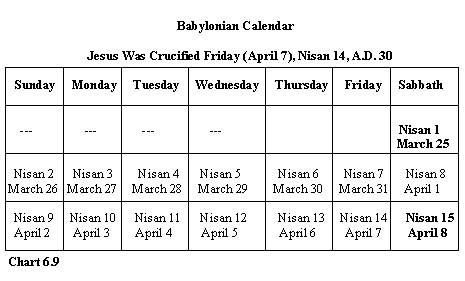
History reveals the
Jewish nation synchronized Nisan 1,
with the sighting of the first
crescent of a new moon at the time of
Christ. (Incidentally, this practice
has not changed since the time of
Christ.) Depending on the visibility
afforded by weather and the position
of Sun and the orbit of the moon, the
first sighting of the crescent of a
new moon in Jerusalem occurs between
sixteen and forty hours after
conjunction. Since it is impossible
to precisely determine when the
crescent of a new moon was sighted in
A.D. 30, we have to let Bible facts
help put the pieces together. The
following facts help us to determine
the correct date: 1) since the
sighting of a new moon crescent
usually occurs two days after a new
moon; 2) since Jesus was arrested on
the night after He ate the Passover
with His disciples; and 3) since the
Jews observed Nisan 15 on a
seventh-day Sabbath the year of
Christ’s death (John 19:14-31),
these facts indicate Nisan 1 (using
the Babylonian calendar) had to occur
on Sabbath (March 25), and the death
of Jesus occurred on Nisan 14, which
was Friday, April 7.
The Lamb of God died
on the cross about 3 p.m. Friday
afternoon (April 7) and was buried
before sundown because a special
Sabbath was about to begin. Special
or high Sabbaths occurred when two
Sabbath rests coincided. When
required feasts like the Passover
occurred on a seventh-day Sabbath, a
“high Sabbath” occurred.
(John 19:31) In summary, we know the
following facts: 1) We know the
astronomical positions of the Sun and
moon for A.D. 30; 2) We know that
Jesus properly observed the Passover
using God’s new moon reckoning
for the beginning of a month; 3) We
know that Jesus rested in the tomb
over Sabbath and rose on the first
day of the week (John 20:1; Acts
10:40); and 4) We know that A.D. 30
occurred in the middle of the
seventieth week. This information
leads to a solid conclusion: Jesus
was crucified on Friday, April 7 A.D.
30 (Nisan 14). The actions of Jesus
(such as eating Passover with His
disciples) and the astronomical
positions of the Sun and moon are two
witnesses that confirm the truth. No
wiggle room is left. A.D. 30 is
the only year during the seventieth
week that will satisfy all the
necessary specifications.
The Seventy Weeks
Nailed Down
If A.D. 30 is the year
of Christ’s death, the seventy
weeks prophecy has no wiggle room
left in it. There is amazing harmony
from several sides. Consider the
following:
- The seventy
weeks have to begin with a
Sunday year because a week of
years always begins with a
Sunday year. The synchrony of
the week of years from the
year of the Exodus and A.D.
30 proves that 457 B.C. is a
Sunday year.
- The seventy
weeks have to begin with a
Year of Jubilee because of
the specification of
“seven weeks and
sixty-two weeks.” The
synchrony of Jubilee cycles
from the year of the Exodus
confirms that 457 B.C. is a
year of Jubilee, and
according to Luke 3, Jesus
began His ministry 483 years
later, in the Sunday year of
the seventieth week, A.D. 27.
- The appearance
of the wise men at the birth
of Jesus affirms their
understanding of the
sixty-nine weeks mentioned in
Daniel 9. No other prophecy
in the Bible points to the
time of Christ’s birth.
- According to
Luke 1:17, John the Baptist
began his ministry before
Jesus appeared. The baptism
of Messiah occurred during
the fifteenth year of
Tiberius Caesar, which is
A.D. 27 – which is the
fist year of the seventieth
week.
- The Jubilee
calendar and the decree of
Artaxerxes in 457 B.C. forces
A.D. 30 to be in the middle
year of the seventieth week
– Jesus died at just the
right time.
- The
astronomical position of the
Sun and moon in A.D. 30
confirms that Jesus and His
disciples ate Passover at the
correct time according to
God’s calendar.
- The actions of
the Jews and their use of the
moon’s first crescent
method are consistent with
the course of events
described in the four
gospels. Jesus was crucified
on the day when the national
Passover lamb was
slaughtered, Friday, April 7,
A.D. 30.
- Constantine
refers to the fact that Jews
frequently observed two
Passovers in the same year
and used this anomaly to
prevent Christians from
depending on the Jews to set
the date of Easter.
The writers of the
four gospels are in perfect harmony
on the timing of these events.
When these nine points
are woven together, all wiggle room
concerning the timing of the
seventieth week is eliminated. No
other time frame can meet or satisfy
the prophetic or astronomical
synchrony required for the seventieth
week. The overwhelming abundance
of harmonious facts supports the
conclusion that the seventieth week
occurred from Spring A.D. 27 to
Spring A.D. 34.
The Year of the
Lord’s Favor
Notice what Luke says
about the first days of Christ’s
public ministry in A.D. 27: “He
[Jesus] went to Nazareth,
where he had been brought up, and on
the Sabbath day he went into the
synagogue, as was his custom. And he
stood up to read. The scroll of the
prophet Isaiah was handed to him.
Unrolling it, he found the place
where it is written: ‘The Spirit
of the Lord is on me, because he has
anointed me to preach good news to
the poor. He has sent me to proclaim
freedom for the prisoners and
recovery of sight for the blind, to
release the oppressed, to proclaim
the year of the Lord’s
favor.’ Then he
rolled up the scroll, gave it back to
the attendant and sat down. The eyes
of everyone in the synagogue were
fastened on him, and he began by
saying to them, ‘Today this
scripture is fulfilled in your
hearing.’” (Luke
4:16-21, italics mine) Some people
twist these words to mean A.D. 27 is
a year of Jubilee. They claim Jesus
expressed the idea of freedom from
slavery in this passage because the
first year of His ministry was a year
of Jubilee. The trouble with this
argument is that slaves were not set
free in the year of Jubilee. They
were set free every seven years.
(Exodus 21:2; Jeremiah 34: 13-16)
Because the slaves were set free in
the forty-ninth year, there were no
slaves at the beginning of the
fiftieth year. Furthermore, if A.D.
27 were a year of Jubilee or even a
Sabbatical year, then several dating
changes would be required which
history and prophecy do not support.
The astronomical data for A.D. 30,
plus the harmony of the gospels, plus
the count of years established in Old
Testament prophecy makes an airtight
case. The words of Jesus in Luke 4
are to be understood within the
context that “the year of the
Lord’s favor” is the first
year of the seventieth week! The
prophecy of Daniel was fulfilled when
Jesus spoke these words. Messiah had
appeared!
Time Is Constant
Time on Earth has been
constant since Creation. Therefore,
the positions of the Sun and moon can
be calculated over long spans of
time. Any deviation from this
constant requires massive changes in
planetary physics. Time is study and
unbroken continuum, and any tampering
with dates will distort everything
forward and backward in time. In Luke
3, we find that Jesus baptized in A.D
27, and in Luke 4, He began His
ministry with the declaration
recorded in verses 16-21. The
expression “to proclaim the year
of the Lord’s favor” that
Jesus used to indicate that He, God
in the flesh, had come from Heaven to
usher in the kingdom of God, if
Israel was willing.
Back to Gabriel’s
Statements, Numbers 4-6
Given the amount of
information examined so far, I may
need to remind you that we are still
studying Daniel 9. Gabriel’s
comments to Daniel were brief, but
they were full of meaning! Earlier in
this segment, I paraphrased
Gabriel’s remarks to Daniel as
six statements. Now that the purpose
of the seventy weeks has been
examined (Statement 1), and the
timing of Messiah’s ministry and
death during the seventieth week has
been examined (Statement 2 and 3),
Gabriel’s final statements about
Israel are very sad. Israel could
have done so well. Israel could have
sealed up this segment of the vision
and prophecy, but it failed to
cooperate with God.
Gabriel predicted:
4. After
they are rebuilt, Jerusalem and the
temple will be destroyed again.
5. Wars
and desolations have been decreed
upon the Jews and Jerusalem.
6. The
Destroyer will continue his deadly
work until the end of time.
Consider this text: “After
the sixty-two ‘sevens,’ the
Anointed One will be cut off and will
have nothing. The people of the ruler
who will come will destroy the city
and the sanctuary. The end will come
like a flood: War will continue until
the end, and desolations have been
decreed.” (Daniel 9:26) This
verse says several things about Jesus
and Jerusalem. Verse 26 predicts that
Messiah will be rejected and disowned
(cut off from Israel, as in having no
inheritance). Then, Gabriel told
Daniel that Jerusalem and the rebuilt
temple would be destroyed again by “the
people of the ruler who will
come….” About six
hundred years later, Jesus Himself
predicted the second temple would be
destroyed when He said to His
disciples, ‘’Do you see
all these things [pointing toward
Jerusalem and the temple]?’
he asked. ‘I tell you the truth,
not one stone here will be left on
another; every one will be thrown
down.’” (Matthew 24:2,
insertion mine) The Romans fulfilled
this prophecy in A.D. 70. When they
broke through the walls of Jerusalem,
a soldier threw a firebrand into the
temple complex. Thousands of Jews
sealed themselves in the temple
thinking that God would not allow His
holy temple to be destroyed. They
were wrong. Fire quickly ignited the
cedar that generously adorned the
edifice. To escape the fire the Jews
threw open the huge temple doors. As
they ran to escape the fire, the
Romans slaughtered them. So many Jews
were killed that day that history
says blood flowed down the temple
steps like a river. Because of the
intense heat from the fire, millions
of dollars in gold ornamentation,
utensils and gold ware melted and the
liquid metal flowed into the cracks
of the stones used to construct the
temple. To recover the gold, Roman
soldiers literally pulled the temple
apart - stone by stone.
Another interesting
point is found in Gabriel’s
choice of words. He said, “The
people of the ruler who will come
will destroy the city and the
sanctuary….” Why did
Gabriel say, “The people of
the ruler….”? These
words have a context and meaning that
need to be understood. In the
previous verse, Gabriel said, “…
From the issuing of the decree to
restore and rebuild Jerusalem until
the Anointed One, the ruler,
comes…” Did you notice
that the Anointed One (Messiah) is
called a “ruler.” Gabriel
elevated the destruction of Jerusalem
in A.D. 70 to that of a divine decree
issued by “the ruler,”
Jesus Christ Himself. The Romans were
sent to destroy Jerusalem by One who
overrules. The Romans were unwitting
servants of God, just like the
Babylonians had been unwitting
servants of God (Jeremiah 25:9) when
they destroyed Jerusalem the first
time. If Israel had cooperated with
God, the world would have enjoyed a
glorious outcome when Jesus came to
Earth! The kingdom of God would have
been established. Israel would have
been a kingdom of priests, the head
of all nations and not the tail.
Unfortunately, Israel refused to
accept Messiah and submit to His
truth. Therefore, “the
Ruler” rejected them again
(Matthew 23:37,38), and in A.D. 70, He
destroyed Jerusalem.
The expression, “The
end will come like a
flood….” Accurately
portrays Rome’s destruction of
Jerusalem. The Romans literally
carried away everything of value as a
flood carries away everything in its
path. In ancient times, the most
destructive force known to the human
race was a flood of water. A pent
–up wall of snowmelt descending
down a mountain ravine in the spring
was an even more devastating force
than fire! Such a flood could remove
huge stonewalls and bury cities in
mud and debris, making recovery
impossible or impractical. (Hosea
5:10; Isaiah 59:19; Isaiah 8:6,7)
Gabriel’s words were fulfilled
in A.D. 70, when the destruction of
Jerusalem and its temple came like a
devastating flood.
Gabriel said, “War
will continue until the end, and
desolations have been decreed [upon
Jerusalem].” (Insertion
mine) The history of the city of
Jerusalem since A.D. 70 has been one
of war and bloodshed, and this will
continue until the end of time.
Contrary to every human effort,
Jerusalem has not been at peace and
it will never be peaceful. Jerusalem
is not the city of God. Two
cultures and religions cannot inhabit
the same space and be at peace. Men
may negotiate a temporary cease-fire,
and Lucifer may establish his throne
in Jerusalem when he appears on
Earth, but there will be no lasting
peace and safety in Jerusalem. God
has decreed it.
Gabriel said, “…
And on the wing of abominations will
come one who makes desolate, even
until a complete destruction, one
that is decreed, is poured out on the
one who makes desolate.” (Daniel
9:27, NASB, insertion mine) The last
portion of verse 27 is hard to
translate smoothly into English. This
explains why we find such diverse
wording in different translations of
the Bible. After reviewing several
respected translations, I have chosen
to use the New American Standard for
this particular verse, because the
ideas expressed in this translation
are easier to understand. Gabriel
predicts an unseen destroyer
[Lucifer] will continue to cause
desolations long after Jerusalem is
destroyed. His rage against
God’s people will not end until
God’s wrath is poured out upon
him. You may recall from Daniel 8,
that the stern-faced king will
eventually become visible. When he
appears, he will destroy everything
in his wake, even the holy people.
Daniel 8 also assures us that this
ruler will be brought to his end, but
not by human power.
A great tragedy is
predicted in Gabriel’s last
three statements. These statements
are compelling and sobering because
Israel’s disaster could have
been diverted. Jesus cried, “O
Jerusalem, Jerusalem, you who kill
the prophets and stone those who sent
to you, how often I have longed to
gather your children together, as a
hen gathers her chicks under her
wings, but you were not willing.
Look, your house is left to you
desolate.” (Matthew
23:37,38) John summarized
Israel’s rebellion and their
rejection of Messiah in one verse
when he wrote, “He came to
that which was his own, but his own
did not receive him.” (John
1:11)



